
 Account
 My Cart
 Back
Back
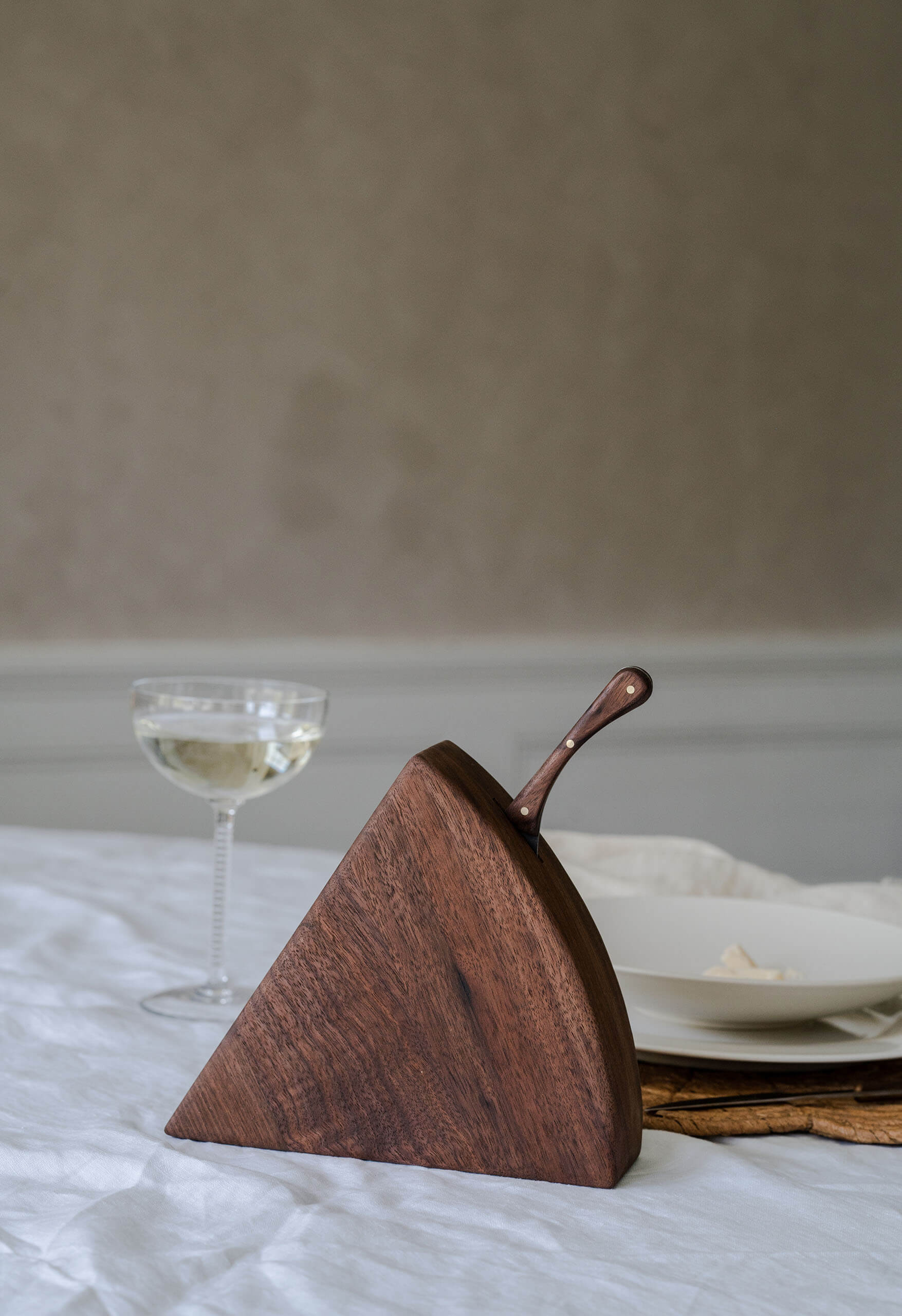
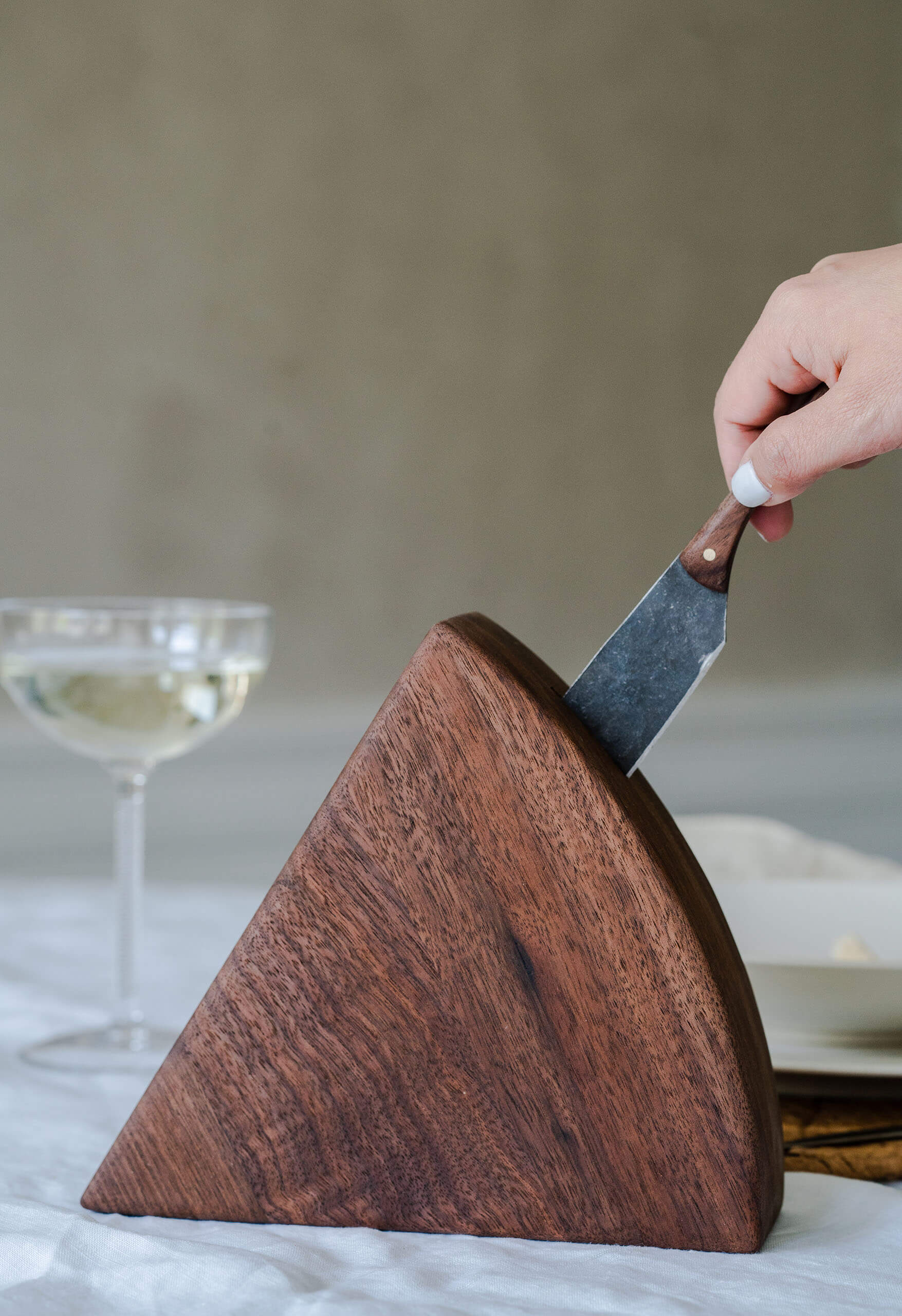


Wooden Cheese Block with Hand Forged Knife
Original price was: $100.00.$58.75Current price is: $58.75.
Order Your Wooden Cheese Block Today!
This sturdy cheese block, resembling a cheese wedge, is handcrafted using locally sourced hardwoods by skilled Amish artisans in Lancaster, Pennsylvania. A kitchen heirloom ready for your table.
In stock
Estimated shipping 5-7 Days
The handcrafted cheese block includes the stainless steel spreading knife that is hand forged and shaped. Each item is also hand-oiled with a food grade oil for the perfect finish.

Sold:
Individually

Material:
Walnut

Made in:
United States
Dimensions: 8" W x 7" H x 2 ½ " D; Knife is 7 1/2" L
Weight: 1lb 11.4oz (27.4oz)
Care: Hand Wash Knife Only; Wipe Clean Cheese Block
We offer ground shipping to 48 states within the continental U.S. (excluding Alaska and Hawaii) and Puerto Rico.
Shop is closing. All sales are final.
Please visit our FAQ page for more information on shipping and returns.
Love + Reviews
FOLLOW OUR INSTAGRAM @ENDLESSLYELATED
The more I research Puerto Rico’s coffee industry, the more I realize how complicated its history really is. And while the numbers may seem discouraging, I’ve also been discovering more local coffee farms and small businesses working to preserve and grow the industry. Case in point: one of my favorite Puerto Rican coffee brands, @wepacoffeecopr. Side note: if you haven’t tried their coffee, you must. You can order it online if you’re not local. Seeing businesses like theirs, alongside other local producers, makes me wonder if we’re already witnessing the beginnings of a resurgence. At least, I certainly hope so.
Sources/Further Reading:
César J. Ayala & Laird W. Bergad, Agrarian Puerto Rico: Reconsidering Rural Economy and Society, 1899–1940, Chapter 2, “The Coffee Economy” (Cambridge University Press, 2020).
Metro Puerto Rico, “Agricultura anticipa impacto al consumidor por alza en el café” (October 4, 2026).
U.S. Department of Agriculture, Coffee: Production, Trade, and Consumption by Countries, Statistics Bulletin No. 79.
Federal Highway Administration, Spanish-American War: General Roy Stone and The New York Times.
USDA Economic Research Service, The Rise and Decline of Puerto Rico’s Sugar Economy.
USDA National Agricultural Statistics Service, 2022 Census of Agriculture: Puerto Rico, Table 44.
Puerto Rico Department of Agriculture, statement published by WIPR (October 2, 2026).
Puerto Rico, Law 232-2015, Ley de Denominación de Origen del Café Puertorriqueño, Articles 2 and 7.
Photo Credits: Eduardo Gorghett — Slide 1
Mike Kenneally — Slides 2, 4 & 6
All remaining photography is my own.

Puerto Rican food doesn’t have to look a certain way, be made in a certain place, or meet anyone else’s standards to be completely ours. It’s ours because it’s ours. ❤️
Growing up, habichuelas were so ordinary to me that I never thought to question their history. In my family, it was usually pink beans, stewed and served alongside white rice, and that was simply dinner. But the more I study Puerto Rican food, the more I realize that some of our most familiar dishes hold the most complicated stories. There’s something deeply unsettling about learning that a food so central to how we eat has remained constant, while our ability to grow it ourselves has changed so dramatically. My hope is that one day, this story begins to reverse itself, and Puerto Rico can once again grow far more of the beans it consumes.
Sources + further reading:
Cruz Miguel Ortíz Cuadra, Eating Puerto Rico: A History of Food, Culture, and Identity, Chapter 2, “Beans.”
Beaver et al., “Contributions in Puerto Rico to Bean, Phaseolus spp., Research,” Journal of Agriculture of the University of Puerto Rico.
University of Puerto Rico Agricultural Extension Service, Manual de la Producción de Habichuelas.
USDA National Agricultural Statistics Service, 2022 Census of Agriculture: Puerto Rico, dry-bean data.
When my mom passed, I lost more than just her. I lost many of her recipes, which only existed because she was around to cook them. I took for granted that she’d always be a phone call away and that I could simply ask, “Mami, cómo se hace [insert dish]?”
After her passing, I remember going back to Puerto Rico, completely lost, in search of something that would bring me closer to her. It was then that I realized Puerto Rican food had completely changed for me. It was no longer just the food I grew up with, but rather the food I was desperately trying to preserve. I found myself asking questions I wish I had asked sooner, sitting with my grandma and aunt, comparing versions, testing recipes, and trying to rebuild what was never written down.
So when I say, “make sure you notice,” I mean it literally.
Sometimes we don’t realize how much something matters until we are suddenly trying to find our way back to it.
[First image is AI-generated using my likeness. All food imagery is original photography.]



Reviews
There are no reviews yet.