
 Account
 My Cart
 Back
Back

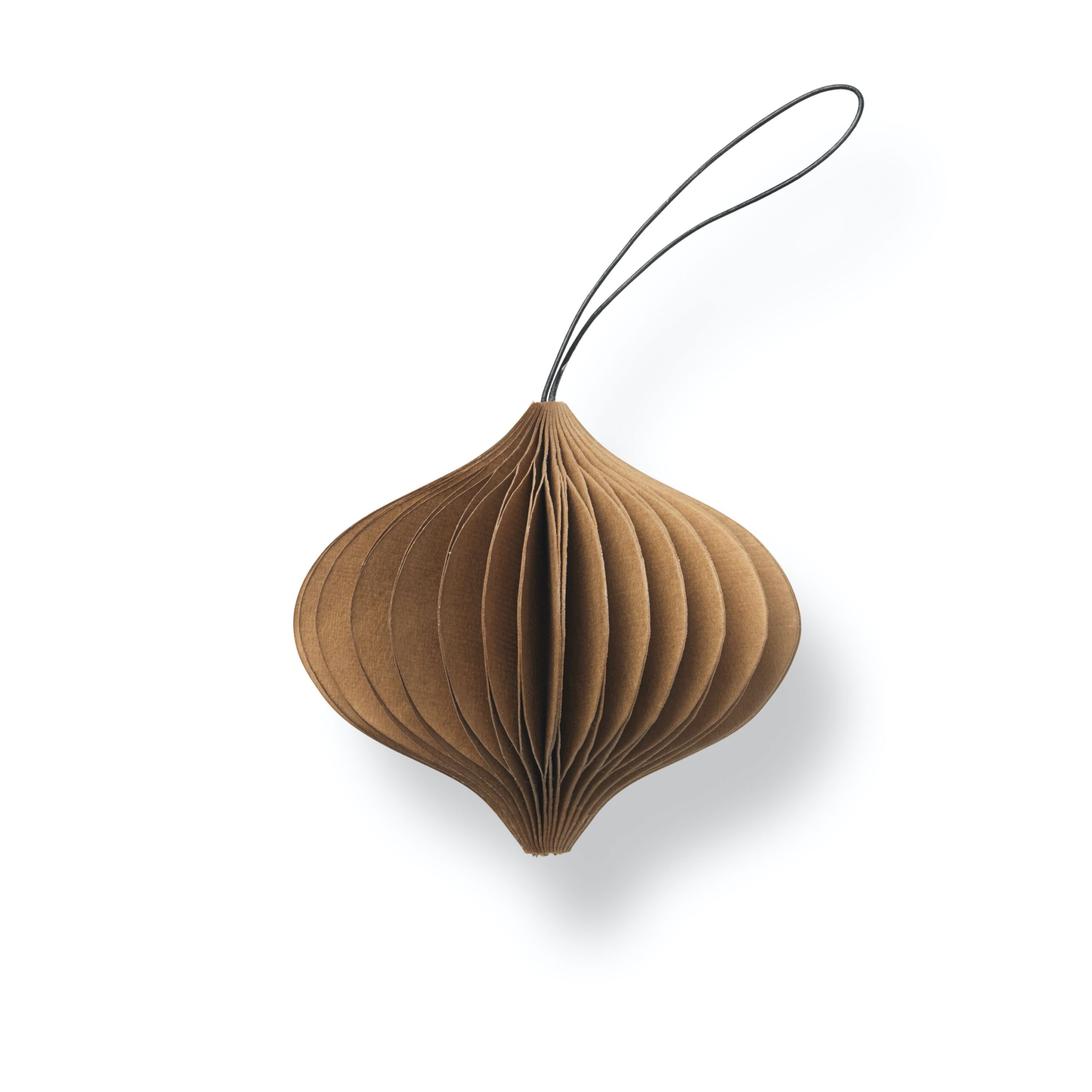


Folded Onion Ornament – Caramel, Set of 4
$30.00
Order Your Folded Ornament Today!
Introducing our Folded Onion Ornament in soft caramel. Crafted from cotton fabric waste, this ornament is the perfect touch of sustainability for your holiday decor. No plastic is used in its thoughtful design.
In stock
Estimated shipping 5-7 Days
Crafted from cotton fabric waste, this folded ornament is attached to a black bio-leather string and with a magnetic closing. Easy to fold out and in. Choose sustainability without compromising on style with this beautiful ornament.

Color:
Caramel

Made In:
India
Sold as a set of 4
Dimensions: 3.5"
Weight: 0.7 oz
We offer ground shipping to 48 states within the continental U.S. (excluding Alaska and Hawaii) and Puerto Rico.
Commitment is scary, so we always take returns. We’re confident you will love your purchase, but if you are unsatisfied for any reason, we offer no-fear returns. You can return your undamaged order (unless damaged upon arrival) for a full refund, 365 days a year, no questions asked.
Please visit our FAQ page for more information on shipping and returns.
Love + Reviews
7 reviews for Folded Onion Ornament – Caramel, Set of 4
FOLLOW OUR INSTAGRAM @ENDLESSLYELATED
My parents migrated from Puerto Rico to New York, where I was born. They crossed water, not an international border. I say this as a daughter of the diaspora, not as an islander, and I do not pretend those experiences are interchangeable. The island and diaspora have been shaped by the same colonial relationship but in very different ways, and I am very well aware of this.
Moreover, I want to be clear that Puerto Rican food is distinctly Puerto Rican. I am not arguing that it should be absorbed into a generic American identity. I am asking why, inside the United States, it is treated as though it arrived with foreigners.
Congress made Puerto Ricans statutory U.S. citizens in 1917. The Supreme Court had already described Puerto Rico as “foreign in a domestic sense,” under U.S. sovereignty, but not fully incorporated into the country. That contradiction followed Puerto Ricans to the mainland and still haunts us to this day.
Too often, unfamiliarity is mistaken for foreignness. What I believe someone really means is not, “This food is foreign.” It is, “I did not grow up with it, and I have mistaken my experience for someone else’s.”
Puerto Rican food does not become less Puerto Rican because U.S. citizens brought it to New York or anywhere else in the country, for that matter. Recognizing it within American life does not erase the island’s identity. It simply refuses the hypocrisy of invoking our citizenship when useful while treating our culture as foreign when we show up as ourselves.
And our right to show up as ourselves is the part I’m not willing to let go of.
Sources / further reading:
Puerto Rico in the American Century: A History Since 1898 by Dr. César J. Ayala and Dr. Rafael Bernabe
The Trials of the Oldest Colony in the World by José Trías Monge.
Puerto Rico: A National History by Dr. Jorell Meléndez-Badillo
Foreign in a Domestic Sense: Puerto Rico, American Expansion, and the Constitution by Christina Duffy Burnett and Burke Marshall, editors

A fun little summer party situation: sea salt chips, grilled sofrito steak, shredded lettuce, pickled red onions, and an avocado garlic mayo dressing tossed right in the bag. Let’s call this Puerto Rican Chips-in-a-Bag.
Ingredients
For the steak:
¾ lb top sirloin steak
2 tablespoons sofrito
½ teaspoon salt-free sazón
½ teaspoon dried oregano
1 tablespoon olive oil
Kosher salt, to taste
Black pepper, to taste
For the avocado garlic mayo dressing:
¼ ripe avocado
3 tablespoons mayonnaise
2 small garlic cloves, finely grated
Juice of 1 lime
¼ teaspoon salt-free sazón
Pinch of dried oregano
Kosher salt, to taste
Black pepper, to taste
1–2 tablespoons water, as needed
For assembling:
1 bag sea salt chips
1 cup shredded lettuce
¼ cup pickled red onions
Chopped grilled steak
Avocado garlic mayo dressing
Recipe
Mix the sofrito, sazón, oregano, olive oil, salt, and black pepper. Lightly coat the steak and marinate for 20–30 minutes at room temperature, or up to 2 hours in the fridge.
Before grilling, remove any heavy excess marinade so the steak can char instead of steam.
Grill over medium-high/high heat for about 3–5 minutes per side, depending on thickness and desired doneness. Rest for 5–10 minutes, then chop into bite-size pieces.
For the dressing, blend or mash the avocado, mayo, garlic, lime juice, sazón, oregano, salt, and pepper until smooth. Add water as needed until loose enough to coat everything. A little bit at a time.
Open the bag of chips and add the steak, lettuce, pickled onions, and dressing. Gently shake or fold everything together and serve right away.
Note: I used salt-free sazón, so I added salt separately. If using regular sazón, go lighter on the salt and taste as you go.
Respectfully, let the record reflect. @netflix we are ready.
As I continue recipe testing for my cookbook, I landed on Bacalao Guisado con Viandas this week. A dish that unexpectedly reminded me why this work has become so much bigger than simply documenting my mom’s traditional Puerto Rican recipes.
Yes, that’s still the goal, but what I’ve realized is how deeply my own perspective, project, and understanding of our food has expanded. The deeper I go, the more I recognize the wisdom built into the food I grew up eating. The intricate steps that a seemingly modest dish requires.
Particularly with this one, I took note of the soaking. The desalting. The gentle, precise simmer that kept the fish from falling apart.
None of it accidental. All of it intentional. And while I inherently knew this, it has become much more evident to me now.
You see, I’m not simply following written instructions as I test these recipes. Instead, I’m learning to meticulously gather what remains.
It has become a meditative process of testing, adjusting, and trying again. Sitting with my family, asking the questions, and listening for even the smallest details. Comparing what one person remembers with what another person does, then holding all of it against the way my own palate remembers it.
Which then leads me to the broader landscape, where I find myself asking: Where did these ingredients come from? Is there documentation of when this dish came to be? Do we know how it has evolved, or whether it has evolved at all?
What started as a way to recover my mom’s recipes after her passing has become a way to understand the overarching narrative around them. The rich history inside these dishes. The quiet intelligence of our food.
So today, I’m sharing this version as I continue the work.
A plate of Bacalao Guisado con Viandas, as a reminder that Puerto Rican cooking does not have to look elaborate to be worth paying attention to.






spz_neMt –
Где лучше всего seo продвижение заказать — есть ли проверенные площадки?